
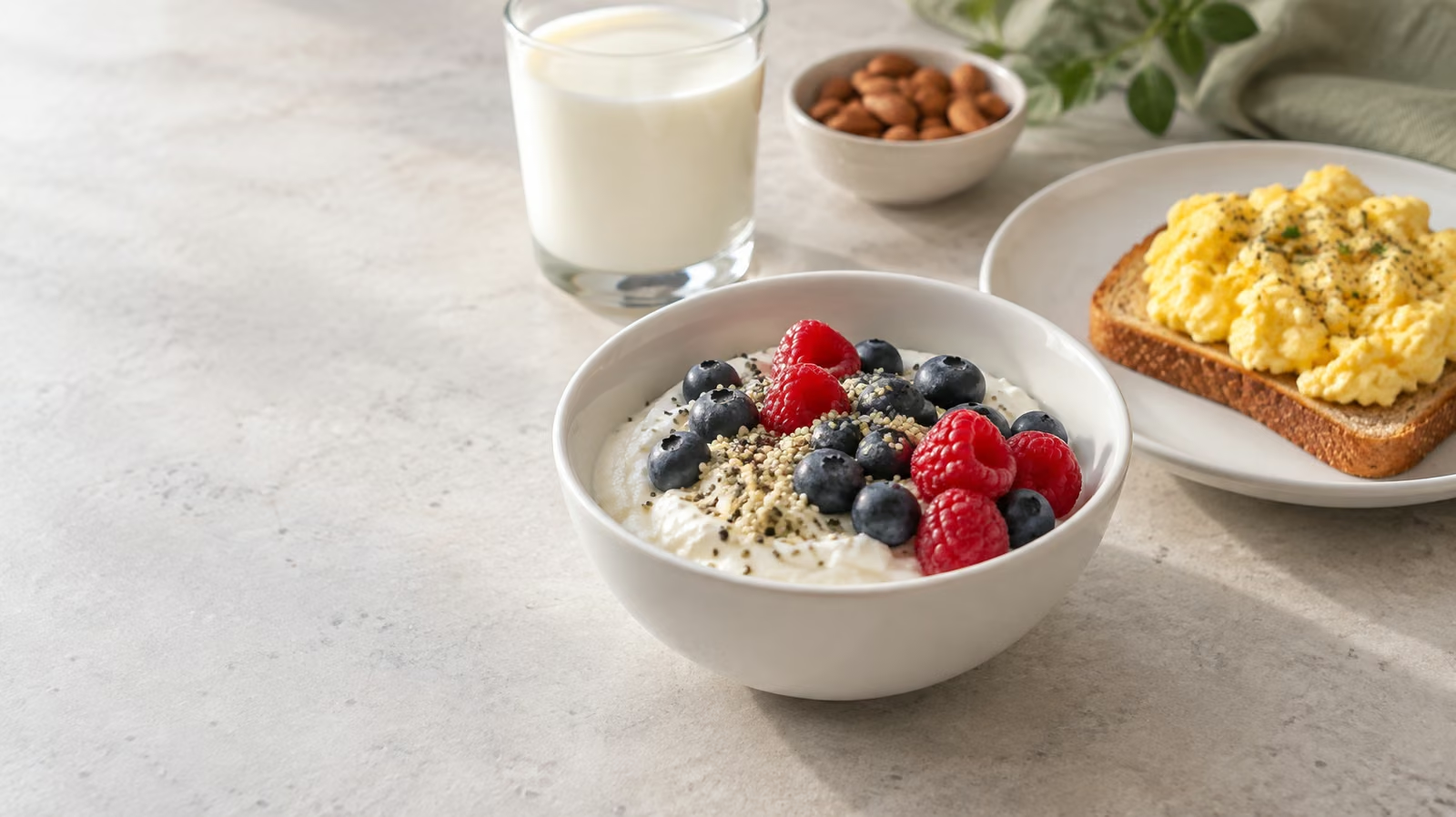
30 Grams of Protein at Breakfast10 easy ways to get there, most with no cooking
Most of us eat the least protein at the meal that’s easiest to fix. Here’s why breakfast matters more as we get older, how much to aim for, and ten breakfasts that reach 25 to 30 grams, most in five minutes or less, several with no cooking at all.
This article is general information, not personal medical or nutrition advice. If you have kidney disease, take medication that affects appetite, or follow a diet your clinician prescribed, check with them before changing how much protein you eat. Read our health disclaimer.

The short version
- Aim for about 25 to 30 grams of protein at breakfast. That’s the per-meal amount muscle research keeps landing on for older adults.1,2
- Most people eat far less. In a Dutch study of nearly 1,300 older adults, breakfast supplied just 10 to 12 grams, versus 24 to 31 grams at dinner.3
- You don’t need to cook. Greek yogurt, cottage cheese, milk, eggs and a scoop of protein powder do most of the work. See the ten breakfasts below.
- Your daily total still matters most. Breakfast is simply the easiest place to add what’s missing. Find your daily number with our calculator.
Every number in this article is footnoted to its source, and every food value comes from the USDA’s own database. See the footnotes.
How do you get 30 grams of protein at breakfast?
Pair one protein-rich base with one booster. A container of plain Greek yogurt (17 g) topped with 3 tablespoons of hemp hearts (about 9½ g) gives about 27 grams. Two eggs (13 g) with ½ cup of cottage cheese (12 g) and a slice of whole-wheat toast (4 g) gives about 28 grams. Most options need no cooking.10
Why breakfast is the meal to fix
Picture three buckets: breakfast, lunch and dinner. Most of us fill the dinner bucket until it overflows and leave the breakfast bucket nearly empty. Your muscles can’t “save” the overflow from dinner for tomorrow morning, so the empty bucket is the one worth filling.
Here’s what the research says, including the parts that don’t line up neatly:
Older muscles need a bigger signal
As we age, muscle responds less to small amounts of protein. Older men needed more protein in one meal than younger men to get the same muscle-building response.2 A review put the useful amount at about 25 to 30 grams per meal, with a weaker response below about 20 grams.1
Spreading protein evenly helped in some studies
In one well-known trial, muscle building over 24 hours was 25 percent higher when protein was spread evenly (about 30 grams per meal) than when it was loaded at dinner. The trial was small, and its participants averaged 37 years old.4
What this adds up to: get your daily total right first. Then, if breakfast is your lightest meal, it’s the easiest and most useful place to add protein. One more reason it works: in a study of about 500 adults over 55, people who ate 10 grams more protein at breakfast ended the day with about 3 to 5 grams more protein overall. Some of the extra was offset later in the day, but not all of it.9
Where most breakfasts fall short
See as a table
| Common breakfast | Approximate protein | Versus 25–30 g |
|---|---|---|
| Oatmeal made with water, plus a banana | ~7 g | Falls well short |
| Oatmeal (½ cup dry oats) made with 1 cup of 2% milk | ~13 g | About half |
| Two eggs on one slice of whole-wheat toast | ~17 g | About half |
| Two eggs, one container (¾ cup) of Greek yogurt, berries | ~30 g | Reaches it |
Values come from USDA FoodData Central and are rounded. Brands vary, so check the label on what you buy.10
The pattern is the same in most homes: breakfast leans on bread, cereal and fruit, which are mostly carbohydrate. In the Dutch study above, more than half of breakfast protein came from plant foods, mostly bread.3 The fix usually isn’t a new recipe. It’s adding one protein-dense food to what you already eat.
The building blocks
Think of breakfast as a base plus a booster. Pick one or two, and you’re most of the way there.
Protein powder varies by brand. Check the label, or compare powders in our whey and plant-based rankings.
Ten breakfasts that reach 25–30 grams
No cooking (under 5 minutes)
Each bar shows where the protein comes from. The black line marks 30 grams.
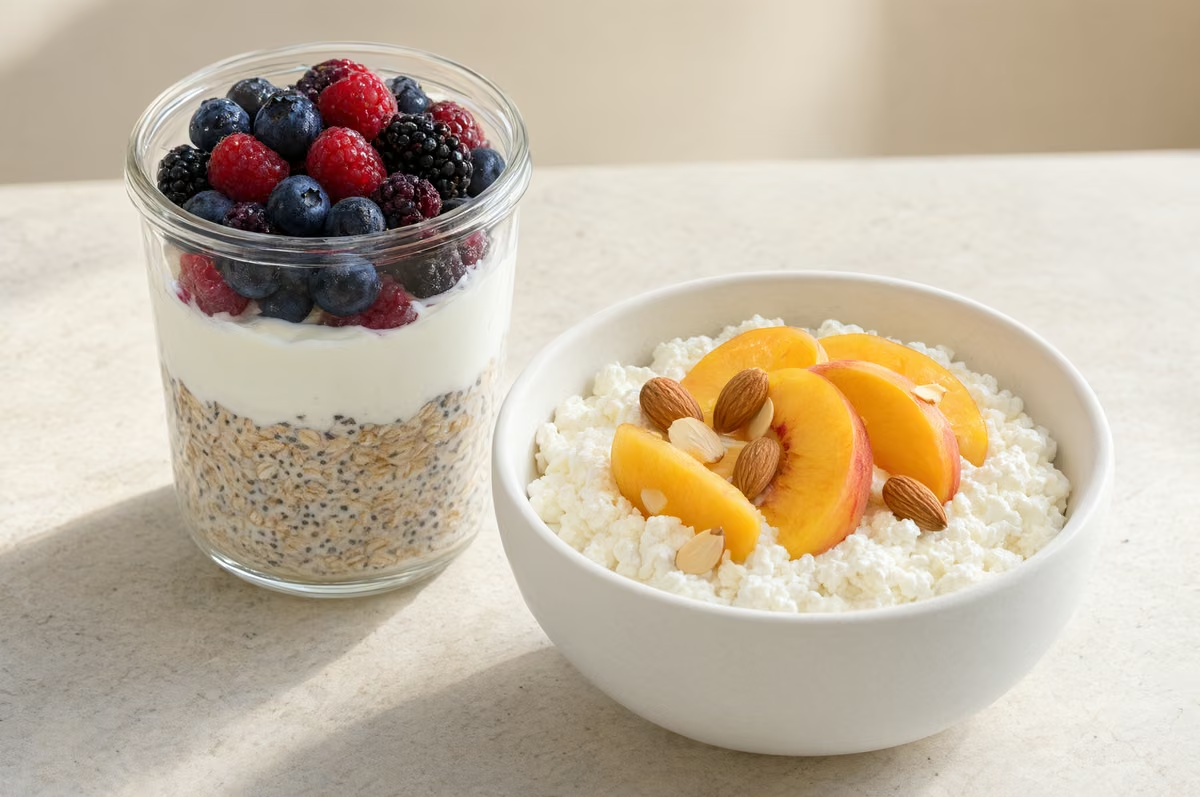
1. Greek yogurt bowl
One container (¾ cup) of plain Greek yogurt, 3 Tbsp hemp hearts, berries.
2. Cottage cheese and fruit
1 cup cottage cheese, sliced peaches or pineapple, 1 oz almonds.
3. Overnight oats
½ cup oats soaked overnight in ½ cup milk and one container (¾ cup) of Greek yogurt.
4. Protein shake
One scoop of protein powder blended with 1 cup milk and a banana. The milk and banana give about 9 g, so a scoop with 20 g brings it to about 29 g.
5. Kefir smoothie
1 cup plain kefir, one container (¾ cup) of Greek yogurt, 2 Tbsp peanut butter, frozen berries.
Quick cooking (about 10 minutes)
6. Eggs with cottage cheese
Two eggs scrambled with ½ cup cottage cheese stirred in, one slice of whole-wheat toast.
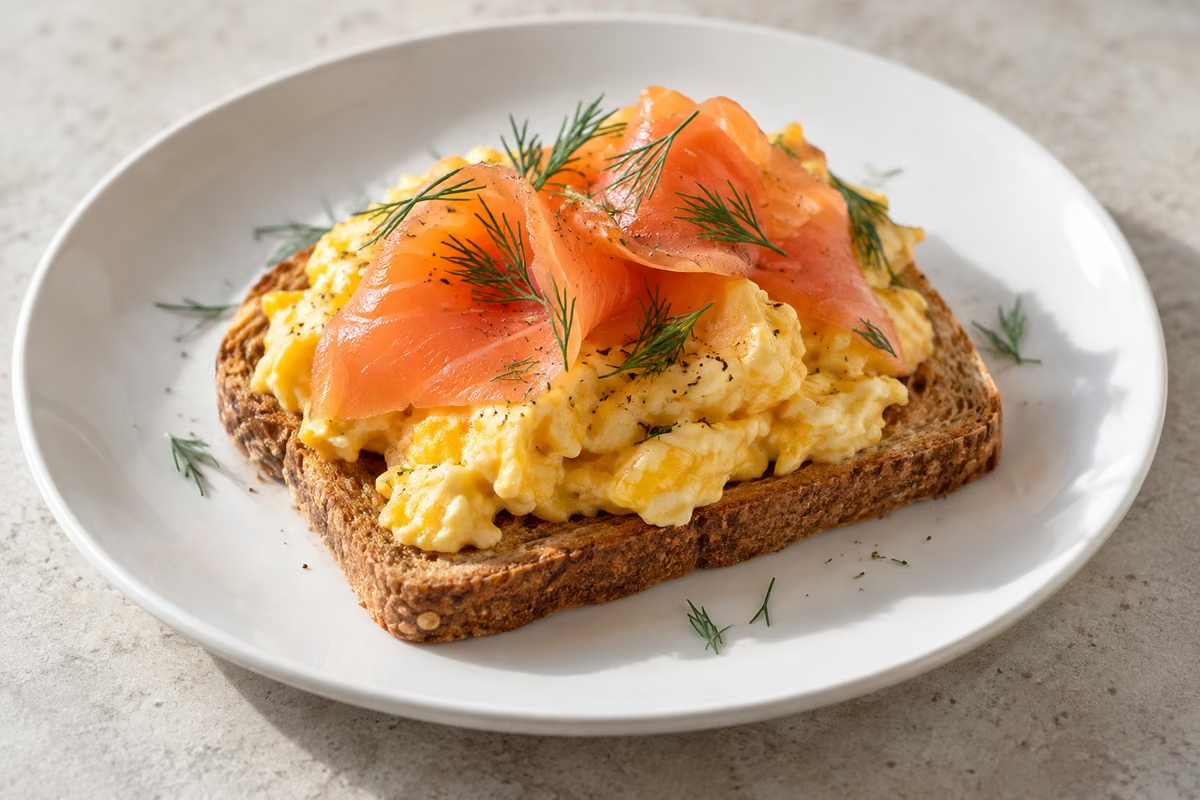
7. Smoked salmon toast
3 oz smoked salmon and two scrambled eggs on one slice of whole-wheat toast.
8. Ricotta toast
½ cup part-skim ricotta on two slices of whole-wheat toast, topped with a soft-boiled egg.
No eggs or dairy
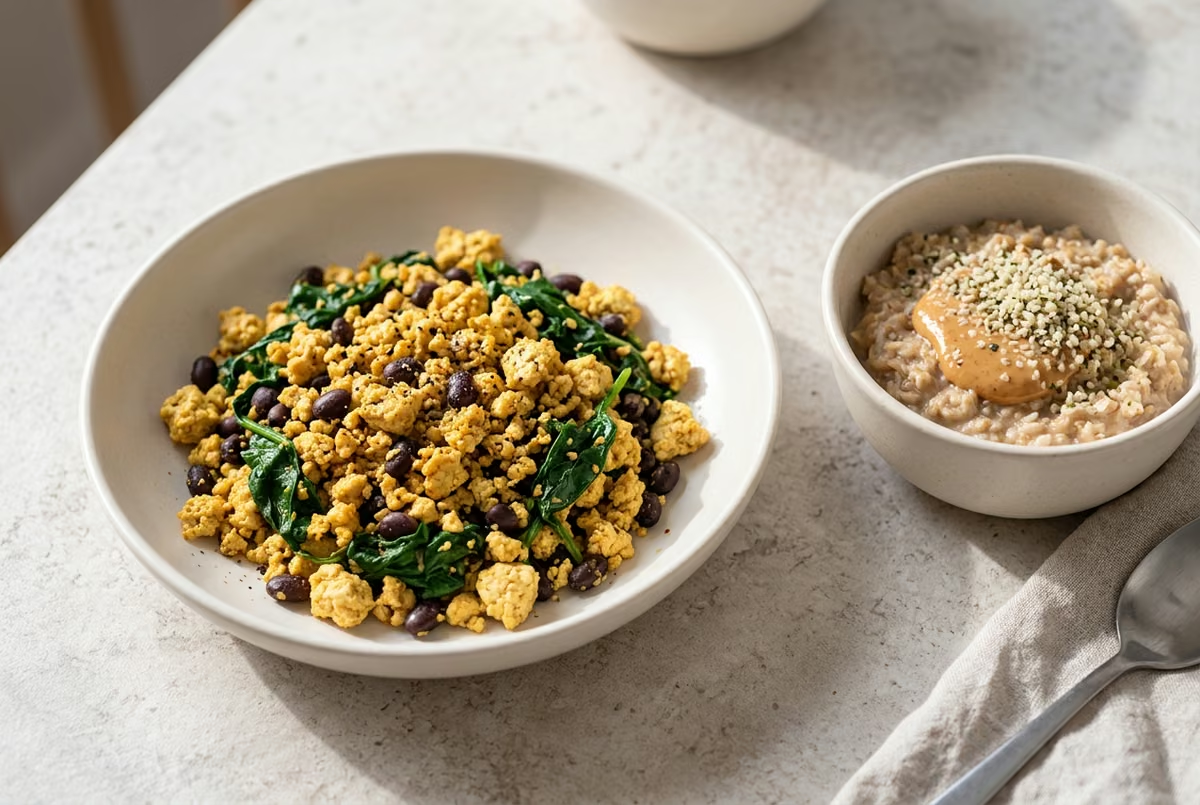
9. Tofu scramble
½ cup crumbled firm tofu with ¼ cup black beans and spinach.
10. Soy milk oats
½ cup oats cooked in 1 cup soy milk, topped with 2 Tbsp peanut butter and 3 Tbsp hemp hearts.
Totals add the protein foods in each breakfast using USDA values. Fruit and vegetables add a gram or two.10
If your appetite is small in the morning
Plenty of people simply aren’t hungry early, especially as they get older, and some medications reduce appetite further. A few things help:
- Pick protein-dense foods. Greek yogurt and cottage cheese carry more protein per bite than most breakfast foods.
- Drink part of it. A shake or a glass of milk or soy milk adds protein without much chewing or fullness.
- Split it if you need to. Have half at breakfast and half mid-morning. It still raises your daily total, which matters most.
- Start where you are. Moving from 10 grams to 20 is real progress.
Common questions
How much protein should you eat at breakfast?
For most adults, about 25 to 30 grams. That’s the per-meal amount muscle research points to, and older muscles need that larger dose more than younger ones do.1,2 If your appetite is small, any step up from where you are now helps, and your daily total matters most.
What does 30 grams of protein at breakfast look like?
One container of plain Greek yogurt with 3 Tbsp of hemp hearts and berries (about 27 g). Or two eggs scrambled with ½ cup of cottage cheese, plus a slice of whole-wheat toast (about 28 g). The ten breakfasts above give you more options.
Is a protein shake good for breakfast?
It can be, especially when you’re short on time or appetite. A scoop of powder blended with 1 cup of milk and a banana gives about 29 grams if the scoop has 20. Ready-to-drink shakes vary widely in protein and sugar, so read the label. A shake has less fiber than a breakfast of oats, fruit or beans, so add fruit or oats to the blender if you can.
Is 30 grams of protein at breakfast too much?
For most healthy adults, no. It’s about what’s in one container of Greek yogurt topped with 3 Tbsp of hemp hearts. If you have kidney disease or your clinician has limited your protein, follow their advice. See who should be careful.
Can I just eat more protein at dinner instead?
Your daily total matters most, and some research in older adults found no difference between even and dinner-heavy eating.5 But most studies of everyday eating link a more even spread with greater strength,7,8 and breakfast is usually the easiest meal to add to.
Do I need protein powder?
No. Every breakfast above except the shake uses ordinary food. Powder is simply convenient when you’re short on time or appetite. If you use one, our whey and plant-based rankings compare 40 powders on Third-Party Verification, Cost per 30 g of Protein, Protein per 100 Calories and Label Transparency.
Does protein at breakfast help with weight loss?
Protein is filling, and keeping muscle matters when you’re losing weight. This guide is about meeting your protein needs, not a weight-loss plan. Our calculator adjusts your number if you’re losing weight.
How much protein do I need in a whole day?
It depends on your weight, age and activity. Our calculator gives you a personal range in about a minute and shows how to spread it across your meals.
Where to next
Get our free 7-day protein meal plan, plus the label checklist
Join the email and you’ll get a week of everyday meals at about 25 to 35 grams of protein each, our protein label checklist and a fill-in protein plan, all in one download as soon as you confirm. After that, about twice a month: new guides and rankings as they publish, and what changed when we update a score.
Plus a heads-up when we post a new guide or our rankings or prices change.
You’ll get one email to confirm your address. After that, about two emails a month, never more than one a week, and you can unsubscribe in one click. We never sell your data.
The skeptic’s footnotes
Study sizes, exact results and our method, for anyone who wants to check the work.
- How much protein per meal. Paddon-Jones D, Rasmussen BB. Dietary protein recommendations and the prevention of sarcopenia. Curr Opin Clin Nutr Metab Care. 2009;12(1):86–90. doi:10.1097/MCO.0b013e32831cef8b
- Older vs younger muscle. Moore DR, Churchward-Venne TA, Witard O, et al. Protein ingestion to stimulate myofibrillar protein synthesis requires greater relative protein intakes in healthy older versus younger men. J Gerontol A Biol Sci Med Sci. 2015;70(1):57–62. Men averaging about 71 years old vs about 22. doi:10.1093/gerona/glu103
- What older adults eat at breakfast. Tieland M, Borgonjen-Van den Berg KJ, van Loon LJ, de Groot LC. Dietary protein intake in Dutch elderly people: a focus on protein sources. Nutrients. 2015;7(12):9697–9706. Nearly 1,300 older adults. doi:10.3390/nu7125496
- Even vs dinner-heavy eating, younger adults. Mamerow MM, Mettler JA, English KL, et al. Dietary protein distribution positively influences 24-h muscle protein synthesis in healthy adults. J Nutr. 2014;144(6):876–880. Even pattern about 30 g per meal; skewed pattern about 11 g at breakfast and 63 g at dinner. doi:10.3945/jn.113.185280
- Even vs dinner-heavy eating, adults 65 to 80. Justesen TEH, Jespersen SE, Tagmose Thomsen T, et al. Comparing even with skewed dietary protein distribution shows no difference in muscle protein synthesis or amino acid utilization in healthy older individuals: a randomized controlled trial. Nutrients. 2022;14(21):4442. doi:10.3390/nu14214442
- Follow-up on protein balance. Agergaard J, Justesen TEH, Jespersen SE, et al. Even or skewed dietary protein distribution is reflected in the whole-body protein net-balance in healthy older adults: a randomized controlled trial. Clin Nutr. 2023;42(6):899–908. doi:10.1016/j.clnu.2023.04.004
- Even spread and strength, 1,741 older adults. Farsijani S, Payette H, Morais JA, et al. Even mealtime distribution of protein intake is associated with greater muscle strength, but not with 3-y physical function decline, in free-living older adults: the NuAge study. Am J Clin Nutr. 2017;106(1):113–124. Adults aged 67 to 84. doi:10.3945/ajcn.116.146555
- Meals with 30 g or more, 1,080 US adults. Loprinzi PD, Loenneke JP, Hamilton DL. Leisure time sedentary behavior, physical activity and frequency of protein consumption on lower extremity strength and lean mass. Eur J Clin Nutr. 2017;71(12):1399–1404. Adults aged 50 to 85. doi:10.1038/ejcn.2017.101
- More at breakfast, more all day. Verreijen AM, van den Helder J, Streppel MT, et al. A higher protein intake at breakfast and lunch is associated with a higher total daily protein intake in older adults: a post-hoc cross-sectional analysis of four randomised controlled trials. J Hum Nutr Diet. 2021;34(2):384–394. About 500 adults over 55. doi:10.1111/jhn.12838
- Food values. U.S. Department of Agriculture, Agricultural Research Service. FoodData Central, SR Legacy (April 2018). fdc.nal.usda.gov. Food values read October 19, 2026; FDC IDs are listed in our data file. Breakfast totals add the protein foods in each breakfast and round to the nearest gram.