
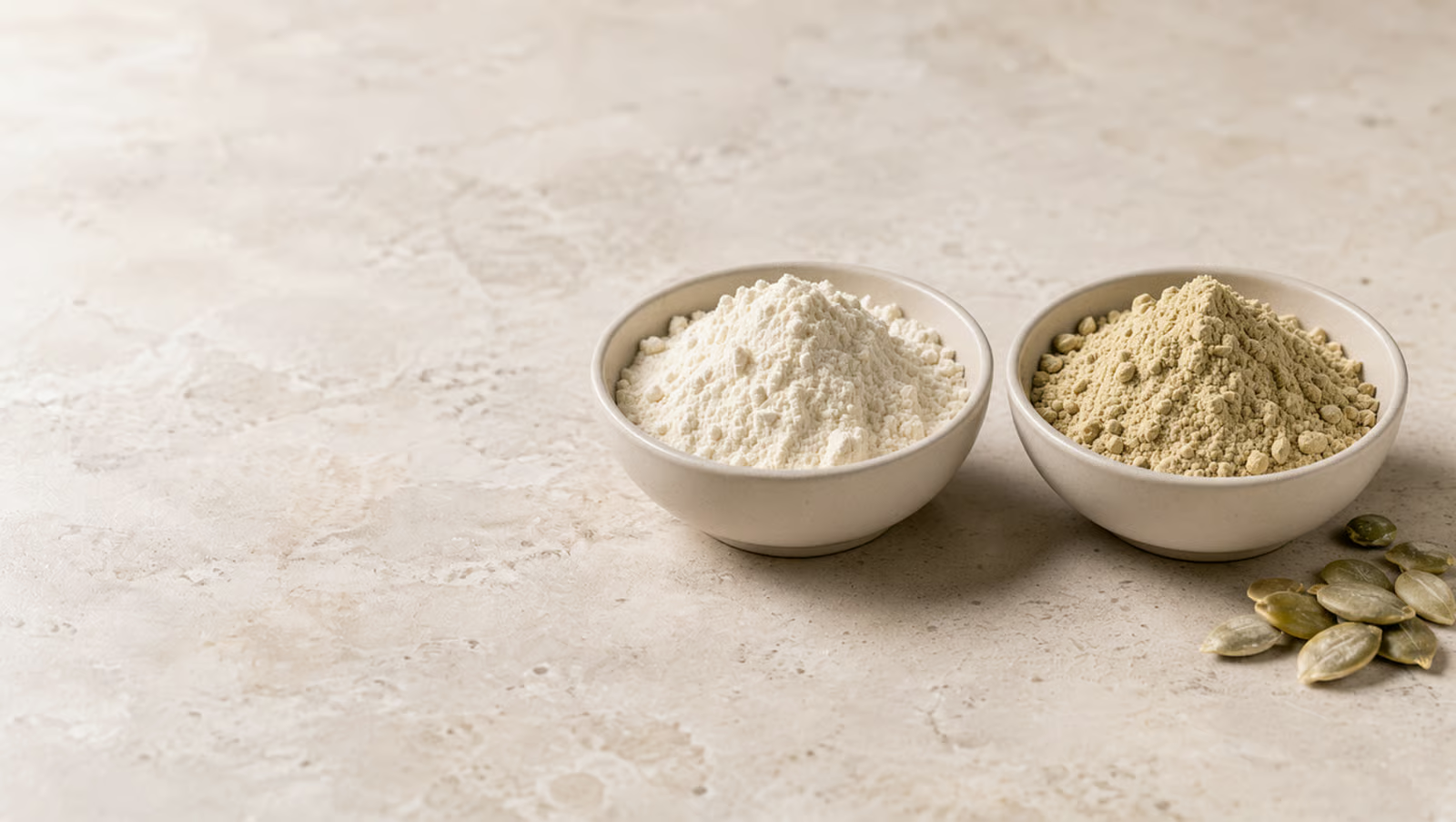
Pea and Other Plant Proteins vs Whey ProteinWhat’s different, what’s not, and who each is for
We scored 40 powders, 20 whey and 20 plant, on protein per scoop, cost and testing records, and read the trials that compared them head to head. The two are closer than the labels suggest, and the real differences are easy to work around.
This article is general information, not personal medical or nutrition advice. If you have a kidney condition, a food allergy or a diet prescribed by your clinician, check with them before adding a protein powder. Read our health disclaimer.

The short version
- Both work. In the trials that compared them directly, people taking pea protein and people taking whey ended up with similar gains in muscle size and strength.1,2 Total protein across your day, plus resistance exercise, matters more than which tub it comes from.
- Whey packs more protein per scoop and per calorie. Across the 40 powders we scored, the typical whey gave 25 g of protein per scoop and 20.8 g per 100 calories. The typical plant powder gave 20 g per scoop and 16.7 g per 100 calories.3
- Cost is about even. The typical cost for 30 g of protein was $2.37 for whey and $2.43 for plant. The cheapest powder per gram of protein in either group was a plain pea protein.3
- Whey is a milk protein. It is not an option with a milk allergy. If lactose bothers you, a whey isolate carries less lactose than a whey concentrate, and plant powders carry none.4
- Plant powders vary more. Most are blends with longer ingredient lists. Pea on its own is low in one essential amino acid, which a blend or the rest of your meals can cover.5,6
Every number in this article is footnoted to its source, and the product figures come from our own scoring, which anyone can reproduce. See the footnotes.
At a glance
What they have in common
Whey and plant protein powders are made the same basic way: start with a food, strip out most of the fat and carbohydrate, and dry what’s left into a powder that is mostly protein. Whey starts as milk. Plant powders start mostly with yellow peas, often mixed with rice, pumpkin seed or other plants. 18 of the 20 plant powders we scored contain pea.
Both count toward the same daily protein total. For most adults, reaching that total across the day is a bigger lever than which powder supplies it.7 If you haven’t worked out your range yet, our protein calculator shows you where the main guidelines land for your age, weight and activity.
Both are also checked the same way before they reach the shelf, which is to say not at all. Under federal law, the FDA does not approve dietary supplements for safety or effectiveness before they are sold.8 That is why we look for independent testing programs that publish a public record (more on that below).
Where they differ
Here is the side-by-side. The protein, cost and testing figures come from our own scoring of 20 whey and 20 plant powders, priced at Amazon in October 2026; the amino acid figures come from published research.
| Whey | Plant (mostly pea) | |
|---|---|---|
| Comes from | Milk (the liquid left over from cheesemaking) | Mostly yellow peas; 18 of the 20 plant powders we scored contain pea |
| Cost per 30 g of protein (typical) | $2.37 (range $1.76 to $3.10) | $2.43 (range $0.85 to $4.94) |
| Ingredients on the label (typical) | 9 to 10 | 13 to 14 |
| Essential amino acids | All, in ample amounts | All, but pea is low in methionine |
| Leucine (an amino acid tied to muscle building) | Higher | Lower on average |
| Lactose | Some; less in isolates | None |
| Milk allergy | Not suitable | Suitable (check for soy, peanut or other allergens) |
1. Amino acids: the real difference, and a fixable one
Protein is built from amino acids, and nine of them are “essential,” meaning your body can’t make them and has to get them from food. A protein that supplies all nine in useful amounts is often called “complete.”
Whey is about as complete as proteins get. Pea protein contains all nine, but it runs low in methionine.5,6 That gap matters most if pea protein were your only protein, which it almost never is. Rice protein is low in a different amino acid (lysine), so pea and rice cover each other, which is why so many plant powders are pea and rice blends.6 Eggs, dairy, fish, grains and many other foods fill the same gap across a day.
Averages across the proteins tested.6
There is also leucine, the amino acid most closely linked to switching on muscle building. Plant protein isolates carry less of it on average than animal proteins.6 On paper, a plant scoop roughly a quarter larger closes that gap. In practice, the trials below suggest the difference is small when total protein is adequate.
2. What the studies show
The research comparing pea and whey directly is encouraging but thin: two trials, both in younger, active adults.
Pea and whey produced similar gains in arm muscle thickness. The trial was run with the company that makes the pea protein used.1
No differences between pea and whey in strength, body composition or muscle thickness.2
Soy matched milk protein. Other plants came out slightly behind on muscle mass, with no difference in strength. In adults 60 and older, no significant difference.7
The broader picture comes from a 2025 review of 43 trials comparing plant and animal protein. Soy matched milk protein for muscle mass. Other plant proteins (the review’s group included rice, chia, oat and potato) came out slightly behind on muscle mass, and there was no difference in strength or physical performance. In adults 60 and older, the review found no significant difference in muscle mass either way.7
3. Your stomach: lactose, allergies and added fibers
Lactose intolerance
Trouble digesting milk sugar. It causes discomfort, and many people handle small amounts without symptoms. A whey isolate is often worth trying.
Milk allergy
An immune reaction to milk proteins. Whey is a milk protein, so whey is off the table.
Whey isolate is filtered to at least 90% protein, which leaves little room for lactose. Whey concentrate ranges widely in protein content, and more of the rest is lactose.4 Many people with lactose intolerance handle small amounts of lactose without symptoms, so an isolate is often worth trying, but tolerance is individual.9
Plant powders have no lactose, but some bring other ingredients worth checking: soy, peanut, or added fibers such as inulin. If a powder doesn’t sit well, the ingredient list is the first place to look.
4. Protein per scoop and per calorie
Whey is mostly protein; many plant powders add creamers, fibers, greens or “superfood” blends. That’s the main reason the typical plant scoop delivers less protein for its calories (16.7 g per 100 calories vs 20.8 g for whey).3 It isn’t pea itself: the plainest pea powder we scored, a single-ingredient pea protein, delivered 22.5 g per 100 calories, level with the best whey isolates (22.7 g).
See all 40 powders as a table
| Powder | Type | Protein per 100 Calories |
|---|---|---|
| Rule 1 R1 Protein | Whey | 22.7 g |
| Kaged Whey Protein Isolate | Whey | 22.7 g |
| Isopure Zero Carb | Whey | 22.7 g |
| Naked Pea | Plant | 22.5 g |
| Legion Whey+ | Whey | 22.0 g |
| NOW Sports Whey Protein Isolate | Whey | 21.8 g |
| Quest Protein Powder | Whey | 21.8 g |
| Transparent Labs 100% Grass-Fed Whey Isolate | Whey | 21.5 g |
| Nutricost Whey Protein Isolate | Whey | 21.4 g |
| Thorne Whey Protein Isolate | Whey | 21.0 g |
| Naked Whey | Whey | 20.8 g |
| Dymatize ISO100 Hydrolyzed | Whey | 20.8 g |
| Ascent Native Fuel Whey Protein | Whey | 20.8 g |
| Optimum Nutrition Gold Standard 100% Whey | Whey | 20.0 g |
| PEScience Select Protein | Whey | 20.0 g |
| Premier Protein 100% Whey | Whey | 20.0 g |
| Ryse Loaded Protein | Whey | 19.2 g |
| Ghost 100% Whey | Whey | 19.2 g |
| Sunwarrior Warrior Blend | Plant | 18.9 g |
| NOW Sports Organic Pea Protein | Plant | 18.8 g |
| Levels Grass-Fed Whey Protein | Whey | 18.5 g |
| MuscleTech Nitro-Tech 100% Whey Gold | Whey | 18.5 g |
| Legion Plant+ | Plant | 18.5 g |
| Ora Organic So Lean & So Clean | Plant | 17.7 g |
| Garden of Life SPORT Organic Plant-Based Protein | Plant | 17.6 g |
| Vega Sport Premium Protein | Plant | 17.6 g |
| PlantFusion Complete Protein | Plant | 17.5 g |
| Garden of Life RAW Organic Protein | Plant | 16.9 g |
| Vega Protein + Supergreens | Plant | 16.7 g |
| Ritual Essential Protein Daily Shake 18+ | Plant | 16.7 g |
| Momentous Essential Plant-Based Protein | Plant | 16.7 g |
| Optimum Nutrition Gold Standard 100% Plant | Plant | 16.0 g |
| Truvani Organic Plant Based Protein | Plant | 15.4 g |
| OWYN 100% Plant-Based Protein Powder | Plant | 14.3 g |
| Orgain Organic Protein Plant Based | Plant | 14.0 g |
| Sprout Living Simple Pumpkin Seed Protein | Plant | 13.3 g |
| KOS Organic Plant Protein | Plant | 12.5 g |
| BSN Syntha-6 | Whey | 11.6 g |
| PB2 Performance Peanut Protein | Plant | 10.5 g |
| Four Sigmatic Organic Plant-Based Protein | Plant | 10.5 g |
Protein per 100 Calories is a measure of what’s in the scoop. It is not a measure of protein quality, fullness or weight outcomes.
5. Cost
Compare powders by cost per 30 g of protein, not by tub price. Tubs vary in size, scoop size and protein per scoop, so the tub price tells you almost nothing. On that fair basis, whey and plant cost about the same: $2.37 vs $2.43 for 30 g of protein in the typical product.3 The plant field has the wider spread, from $0.85 for a large bag of plain pea protein to $4.94 for a premium pea shake.
See all 40 powders as a table
| Powder | Type | Cost per 30 g of Protein |
|---|---|---|
| Naked Pea | Plant | $0.85 |
| NOW Sports Organic Pea Protein | Plant | $1.51 |
| Premier Protein 100% Whey | Whey | $1.76 |
| PB2 Performance Peanut Protein | Plant | $1.86 |
| Vega Protein + Supergreens | Plant | $2.07 |
| Optimum Nutrition Gold Standard 100% Whey | Whey | $2.10 |
| Orgain Organic Protein Plant Based | Plant | $2.11 |
| Quest Protein Powder | Whey | $2.13 |
| OWYN 100% Plant-Based Protein Powder | Plant | $2.14 |
| Nutricost Whey Protein Isolate | Whey | $2.16 |
| Optimum Nutrition Gold Standard 100% Plant | Plant | $2.19 |
| MuscleTech Nitro-Tech 100% Whey Gold | Whey | $2.20 |
| Garden of Life SPORT Organic Plant-Based Protein | Plant | $2.21 |
| Ryse Loaded Protein | Whey | $2.22 |
| Isopure Zero Carb | Whey | $2.23 |
| Vega Sport Premium Protein | Plant | $2.23 |
| PEScience Select Protein | Whey | $2.31 |
| Kaged Whey Protein Isolate | Whey | $2.32 |
| Transparent Labs 100% Grass-Fed Whey Isolate | Whey | $2.35 |
| PlantFusion Complete Protein | Plant | $2.37 |
| Rule 1 R1 Protein | Whey | $2.38 |
| Ascent Native Fuel Whey Protein | Whey | $2.40 |
| BSN Syntha-6 | Whey | $2.45 |
| Sunwarrior Warrior Blend | Plant | $2.48 |
| Naked Whey | Whey | $2.50 |
| Ghost 100% Whey | Whey | $2.50 |
| Levels Grass-Fed Whey Protein | Whey | $2.56 |
| Legion Whey+ | Whey | $2.73 |
| Legion Plant+ | Plant | $2.81 |
| Garden of Life RAW Organic Protein | Plant | $2.82 |
| NOW Sports Whey Protein Isolate | Whey | $2.88 |
| KOS Organic Plant Protein | Plant | $2.95 |
| Four Sigmatic Organic Plant-Based Protein | Plant | $3.01 |
| Dymatize ISO100 Hydrolyzed | Whey | $3.03 |
| Thorne Whey Protein Isolate | Whey | $3.10 |
| Sprout Living Simple Pumpkin Seed Protein | Plant | $3.18 |
| Truvani Organic Plant Based Protein | Plant | $3.32 |
| Momentous Essential Plant-Based Protein | Plant | $3.41 |
| Ora Organic So Lean & So Clean | Plant | $3.82 |
| Ritual Essential Protein Daily Shake 18+ | Plant | $4.94 |
6. Testing records and heavy metals
Because nobody approves protein powders before sale, we give credit for independent programs that test products and publish a record you can look up yourself: NSF Certified for Sport, Informed Sport and Informed Choice. 9 of the 20 whey powders and 8 of the 20 plant powders held one we could confirm.3 How we score explains exactly what earns credit.
Pea protein vs whey, head to head
To compare the proteins rather than the recipes, here are the four simplest powders we scored: one or two ingredients, unflavored.
| Powder | Type | Protein per scoop | Protein per 100 Calories | Cost per 30 g of Protein |
|---|---|---|---|---|
| NOW Sports Whey Protein Isolate | Whey isolate | 24 g | 21.8 g | $2.88 |
| Naked Whey | Whey, single ingredient | 25 g | 20.8 g | $2.50 |
| Naked Pea | Pea protein | 27 g | 22.5 g | $0.85 |
| NOW Sports Organic Pea Protein | Pea protein isolate | 15 g | 18.8 g | $1.51 |
Prices as checked at Amazon, October 15 to 16, 2026. Naked Pea’s price is for a 5 lb bag; the others are smaller tubs, so part of its lead is the bag size.3
Stripped to the protein, pea and whey look closer than the category averages suggest. The differences that remain are the ones above: amino acid balance, lactose, and taste and texture, which only your own kitchen can judge.
Is plant or vegan protein as good as whey?
Pea matched whey in two small trials, and soy matched milk protein across many. Whey still delivers more protein and more leucine per scoop and per calorie, so a plant powder may need a slightly larger serving. Getting enough total protein and doing resistance exercise matter more than the source.1,2,7
Who each is for
How to choose, in four steps
- Rule things out first. A milk allergy or a vegan diet makes the choice for you: plant. Lactose trouble points to a whey isolate or plant.
- Compare cost per 30 g of protein, and protein per scoop, rather than the price on the tub.
- Look for a testing record you can check. A certification counts only if the program’s own registry lists that exact product. How we score shows how we check.
- Buy the smallest size first. Taste and texture vary more than any number on the label, especially with plant blends.
Where to next
Get our free 7-day protein meal plan, plus the label checklist
Join the email and you’ll get a week of everyday meals at about 25 to 35 grams of protein each, our protein label checklist and a fill-in protein plan, all in one download as soon as you confirm. After that, about twice a month: new guides and rankings as they publish, and what changed when we update a score.
Plus a heads-up when we post a new guide or our rankings or prices change.
You’ll get one email to confirm your address. After that, about two emails a month, never more than one a week, and you can unsubscribe in one click. We never sell your data.
The skeptic’s footnotes
Study sizes, exact results and our method, for anyone who wants to check the work.
- Pea vs whey, 12-week trial. Babault N, Païzis C, Deley G, et al. Pea proteins oral supplementation promotes muscle thickness gains during resistance training. J Int Soc Sports Nutr. 2015;12:3. 161 men aged 18 to 35 enrolled and 137 completed; 25 g of protein twice a day with 12 weeks of upper-body resistance training. Arm muscle thickness rose in every group (whey +15.3%, pea +13.4%, placebo +10.7%), and the differences between groups were not statistically significant, so neither protein beat placebo in the full group. Among the weakest participants at the start, pea beat placebo; whey did not differ from either. The study was funded by Roquette, which makes the pea protein used, and three authors worked for Roquette. link.springer.com/article/10.1186/s12970-014-0064-5
- Pea vs whey, 8-week pilot. Banaszek A, Townsend JR, Bender D, et al. The effects of whey vs. pea protein on physical adaptations following 8 weeks of high-intensity functional training (HIFT): a pilot study. Sports (Basel). 2019;7(1):12. 15 men and women, 24 g of protein around training. Both groups improved squat and deadlift strength; no differences between groups on any measure. A small pilot, so it can miss real differences. doi.org/10.3390/sports7010012
- Our product data. EverAble scoring of 20 whey powders and 20 plant powders. Two plant powders (Momentous Essential Plant-Based Protein and Optimum Nutrition Gold Standard 100% Plant) were added on October 16, 2026 to bring the plant set to 20. Every product is priced at one retailer, Amazon, at the one-time price sold by Amazon.com or the brand’s own Amazon storefront where available; Subscribe & Save, coupons and deal prices are excluded. Whey prices were checked October 15, 2026 and plant prices October 16, 2026. Two whey products are not sold on Amazon in the reviewed version and use the brand’s one-time price; two whey listings and one plant listing are sold only by third-party sellers. Servings are calculated from net weight and scoop size. Cost per 30 g of protein = price ÷ (servings × protein per serving) × 30. Protein per 100 Calories and protein per scoop are from each product’s label. “Typical” is the median. Sport testing certifications counted are NSF Certified for Sport, Informed Sport and Informed Choice, confirmed in each program’s registry for the specific product; some Informed Choice credits were confirmed at product level because the program publishes no readable flavor-level page. Four plant powders are sold on Amazon only in a different size or under an unconfirmed size; their label figures were applied to the Amazon size. The whey figures match our whey protein rankings; the full plant data is in our plant protein rankings.
- Whey isolate vs concentrate. USDA Agricultural Marketing Service, Technical Evaluation Report: Whey Protein Concentrate, April 24, 2015. Whey protein concentrate ranges from 34% to 89% protein; whey protein isolate is at least 90% protein and contains little lactose. ams.usda.gov
- Amino acid scoring. Mathai JK, Liu Y, Stein HH. Values for digestible indispensable amino acid scores (DIAAS) for some dairy and plant proteins. Br J Nutr. 2017;117:490-499. Using the adult reference pattern, whey protein isolate scored 125 and pea protein concentrate 73, limited by the sulfur amino acids (methionine and cysteine). A score of 100 or more means no essential amino acid falls short. Measured in pigs, the accepted model for estimating these values in people.
- Amino acid content of plant proteins. Gorissen SHM, Crombag JJR, Senden JMG, et al. Protein content and amino acid composition of commercially available plant-based protein isolates. Amino Acids. 2018;50(12):1685-1695. Leucine averaged 7.1% of protein in plant isolates vs 8.8% in animal proteins; pea is low in methionine and brown rice in lysine, and the authors note blends can approximate animal proteins. The “quarter larger” figure in the article is our arithmetic: 8.8 ÷ 7.1 ≈ 1.24.
- Plant vs animal protein, 43 trials. Reid-McCann RJ, Brennan SF, Ward NA, et al. Effect of plant versus animal protein on muscle mass, strength, physical performance, and sarcopenia: a systematic review and meta-analysis of randomized controlled trials. Nutr Rev. 2025;83(7):e1581-e1603. Plant protein overall: slightly lower muscle mass (standardized mean difference −0.20). Soy vs milk: no difference (17 trials). Non-soy plant proteins: lower muscle mass (5 trials, −0.58). Strength (14 trials) and physical performance (5 trials): no difference. Adults 60 and older: no significant difference in muscle mass. An earlier review of 16 trials found the same pattern: Lim MT, Pan BJ, Toh DWK, et al. Animal protein versus plant protein in supporting lean mass and muscle strength. Nutrients. 2021;13(2):661. No difference in lean mass measured in kilograms or in strength; a small advantage for animal protein in lean mass as a percentage of body weight, seen in adults under 50 but not in adults 50 and older. Resistance training did not change these results. Soy vs whey with resistance training: Messina M, et al. Int J Sport Nutr Exerc Metab. 2018;28(6):674-685, nine studies, similar gains in strength and muscle. pmc.ncbi.nlm.nih.gov/articles/PMC12166177
- FDA and supplements. U.S. Food and Drug Administration, Information for Consumers on Using Dietary Supplements: “Under DSHEA, FDA is not authorized to approve dietary supplements for safety and effectiveness before they are marketed.” Some protein powders are sold as foods rather than supplements; neither route requires FDA approval before sale.
- Lactose tolerance. University of Kentucky Cooperative Extension, Lactose Intolerance (FCS3-104): most people with lactose intolerance can have about one glass of milk (about 12 g of lactose) without significant symptoms; tolerance varies.
- Heavy metals. Clean Label Project (2018, 2025) and Consumer Reports (2025) reported higher heavy-metal levels in plant powders. Bethencourt-Barbuzano E, et al. J Food Compos Anal. 2025 found a different pattern for lead. Cadmium uptake by rice and seed crops: Uraguchi S, Fujiwara T. Rice. 2012;5:5. The Clean Label Project method has been criticized by industry groups.