
Best Protein Powder for Adults Over 50Six picks from the 40 powders we scored
If you’re over 50, the best protein powder isn’t the one with the boldest label. It’s one with a public testing record, a short ingredient list and enough protein per scoop to make a meal count. We pulled six picks from our whey and plant-based rankings, and explain what matters more as we get older.
This article is general information, not personal medical or nutrition advice. If you have kidney disease, take medication that affects appetite, or follow a diet your clinician prescribed, check with them before changing how much protein you eat. Read our health disclaimer.

The short version
- Best overall: Transparent Labs Grass-Fed Whey Isolate, our #1 whey powder (82 of 100).
- Best dairy-free: NOW Sports Organic Pea, certified, one ingredient, $1.51 per 30 g of protein.
- Smallest tub to try first: NOW Sports Whey Isolate in a 1.2 lb size.
- Food first. Powder is a convenience, not a requirement. Find your daily number with our calculator.
Every score and price on this page comes from our whey and plant-based rankings, which use one published scoring method. See how we score.
Do you need protein powder after 50?
Not necessarily. Most people can meet their needs with food. But needs rise with age. To address the natural changes of aging, the international PROT-AGE Study Group recommends about half a gram per pound for healthy adults over 65, rising higher still for those who stay physically active or are managing illness.1 The reason: as we age, muscle responds less to protein, appetite wanes, and minor illnesses become more frequent.1
That’s where a powder earns its place. A shake or a glass of milk or soy milk adds protein without much chewing or fullness.2 And a scoop stirred into breakfast is one of the simplest ways to get that meal closer to 25 to 30 grams. Our breakfast guide shows ten ways to get there, most without powder.
What matters more after 50
We score every powder on cost, testing records, protein per calorie and label transparency. For adults over 50, a few of those matter more, and a few practical details matter too:
A public testing record
Under federal law, the FDA does not approve dietary supplements for safety or effectiveness before they are sold.3 A certification record you can look up is the best evidence you have. All six picks have one.
Easy on dairy, if that matters
If lactose bothers you, a whey isolate carries less lactose than a whey concentrate, and plant powders carry none.4
Unflavored, so it goes into food
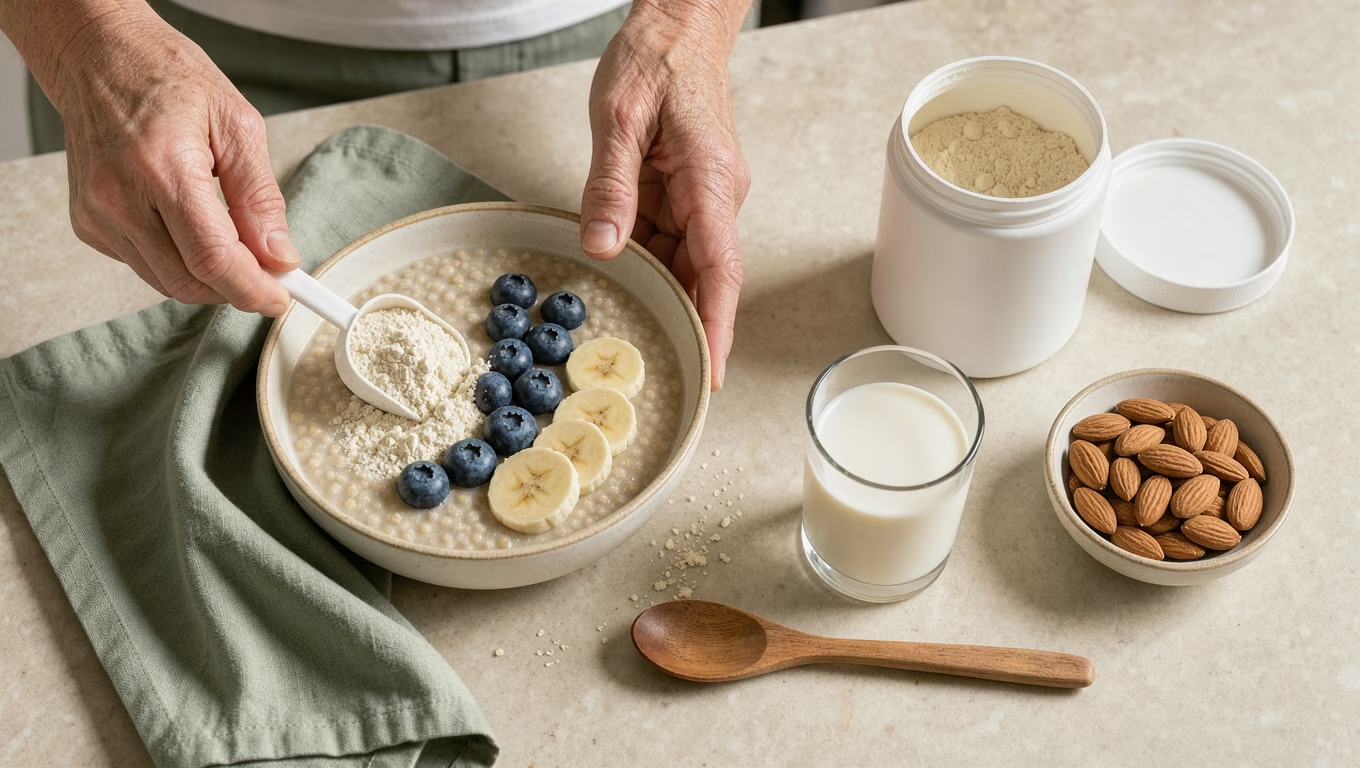
An unflavored powder can be stirred into oatmeal, yogurt or soup, which helps when you don’t want another drink. Five of our six picks are unflavored.
A small tub to try first
Taste and texture are personal. A 1.2 to 1.5 lb tub lets you find out before you commit to a big one.
Protein per calorie
If your appetite is small, more protein per calorie means more protein in fewer bites. All six picks deliver about 19 to 23 g per 100 calories.
A plan for when you’ll use it
Breakfast is usually the meal with the most room. A scoop there is the easiest way to move toward 25 to 30 g at that meal.2
Our six picks
Each pick links to its full review, where you’ll find the score breakdown, the label figures and the evidence we checked.
Transparent Labs 100% Grass-Fed Whey Isolate
Top Tier
Our #1 whey powder. A whey isolate with a public certification record, high protein per calorie and a fully transparent label. Unflavored, so it disappears into oatmeal, yogurt or a smoothie.
Naked Whey
Top Tier
A one-ingredient formula with a public certification record and full marks for label transparency. Nothing to decode on the label.
NOW Sports Whey Protein Isolate
Top Tier
A certified, unflavored isolate in a 1.2 lb tub, so you can see how you like powder before buying a big one. The highest protein per calorie of our six picks.
NOW Sports Organic Pea Protein
Top Tier
One ingredient, a public certification record and the second-lowest cost per 30 g of protein of the 20 plant powders we ranked, in a small tub. No milk, so no lactose.
Naked Pea
Top Tier
Our top-scoring plant powder and the lowest cost per 30 g of protein of all 40 powders we scored. One ingredient, with a public certification record.
Optimum Nutrition Gold Standard 100% Whey
Recommended
Widely sold, flavored and ready to drink with milk or water, with a public certification record and one of the lower costs per 30 g of protein in our whey ranking.
Scores and prices from our rankings, prices checked October 30, 2026. Prices change; check the current price before you buy.
How the six compare
What 30 g of protein costs, our six picks
One-time price on October 30, 2026, at the retailer named in each full review. Lower is cheaper.
| Pick | Type | Score | Cost per 30 g | Protein per 100 cal | Flavor and size scored |
|---|---|---|---|---|---|
| Transparent Labs 100% Grass-Fed Whey Isolate Best overall | Whey isolate | 82 | $2.35 | 21.5 g | Unflavored · 2.2 lb |
| Naked Whey Simplest label | Whey | 80 | $2.50 | 20.8 g | Unflavored · 2 lb |
| NOW Sports Whey Protein Isolate Smallest tub to try first | Whey isolate | 79 | $2.68 | 21.8 g | Unflavored · 1.2 lb |
| NOW Sports Organic Pea Protein Best dairy-free | Pea (plant) | 84 | $1.51 | 18.8 g | Unflavored · 1.5 lb |
| Naked Pea Lowest cost per 30 g | Pea (plant) | 94 | $0.85 | 22.5 g | Unflavored · 5 lb bag |
| Optimum Nutrition Gold Standard 100% Whey Familiar brand, easy to find | Whey | 72 | $2.29 | 20.0 g | Double Rich Chocolate · 1.98 lb |
Why isn’t a cheaper powder here? Several well-known budget powders have no public testing record we could find. For this audience we required one, so Premier Protein 100% Whey, for example, sits in our ranking at 53 but isn’t a pick here.
What about ready-to-drink shakes?
Shakes like Fairlife, Premier Protein and Ensure come up often when people search for protein for older adults, and they’re convenient. We haven’t scored them yet, so we don’t rank them here. If you buy one, read the label the same way: protein per bottle, protein per calorie, added sugar and whether it has a public testing record. Ready-to-drink shakes vary widely in protein and sugar.2
- Kidney disease: if you have kidney disease or your clinician has limited your protein, follow their advice.1
- Milk allergy: whey comes from milk and isn’t suitable. Plant powders don’t contain milk; check the label for soy, peanut or other allergens.4
- Medications and appetite: if a medication affects your appetite or your clinician prescribed a diet, check with them before changing how much protein you eat.
Common questions
What is the best protein powder for seniors?
Look for a public testing record first, then a short ingredient list and good protein per calorie. Our best overall pick is Transparent Labs Grass-Fed Whey Isolate; if you avoid dairy, NOW Sports Organic Pea.
Is whey or plant protein better after 50?
Both can work. Whey has more leucine on average; plant powders have no lactose and suit a milk allergy. Our pea and plant protein vs whey guide compares them in detail.
How much protein powder should I take?
Start with your daily total, then use powder to fill the gap. One scoop is usually 15 to 30 g of protein, depending on the product. Our calculator gives you a personal range in about a minute.
What’s the best protein powder for women over 50?
The same things matter: a public testing record, a clear label and enough protein per scoop. All six picks on this page qualify. If dairy bothers you, start with one of the two pea powders or a whey isolate.
Do I need an unflavored protein powder?
No, but it’s more flexible. Unflavored powder can go into oatmeal, yogurt, soup or a smoothie, which helps if you don’t want another drink. Five of our six picks are unflavored.
Are protein shakes a good alternative?
They’re convenient, and some have a lot of protein. We haven’t scored ready-to-drink shakes yet. Read the label for protein, added sugar and a testing record.
Where to next
Get our free 7-day protein meal plan, plus the label checklist
Join the email and you’ll get a week of everyday meals at about 25 to 35 grams of protein each, our protein label checklist and a fill-in protein plan, all in one download as soon as you confirm. After that, about twice a month: new guides and rankings as they publish, and what changed when we update a score.
Plus a heads-up when we post a new guide or our rankings or prices change.
You’ll get one email to confirm your address. After that, about two emails a month, never more than one a week, and you can unsubscribe in one click. We never sell your data.
The skeptic’s footnotes
Sources and our method, for anyone who wants to check the work.
- Protein needs after 65, and kidney disease. Bauer J, Biolo G, Cederholm T, et al. Evidence-based recommendations for optimal dietary protein intake in older people: a position paper from the PROT-AGE Study Group. J Am Med Dir Assoc. 2013;14(8):542–559. Summarized in our protein guide.
- Per-meal protein and small appetites. See the sources in our breakfast guide, including Paddon-Jones and Rasmussen (2009) and Moore et al. (2015).
- FDA and supplements. U.S. Food and Drug Administration, Information for Consumers on Using Dietary Supplements. Some protein powders are sold as foods rather than supplements; neither route requires FDA approval before sale.
- Lactose and milk allergy. See our pea and plant protein vs whey guide.
- Scores and prices. All product figures come from our whey and plant-based rankings (scoring method published on How We Score). One-time prices checked October 30, 2026; cost per 30 g of protein uses label protein per scoop and servings per container.